Plot Locations
Section A - E Layouts
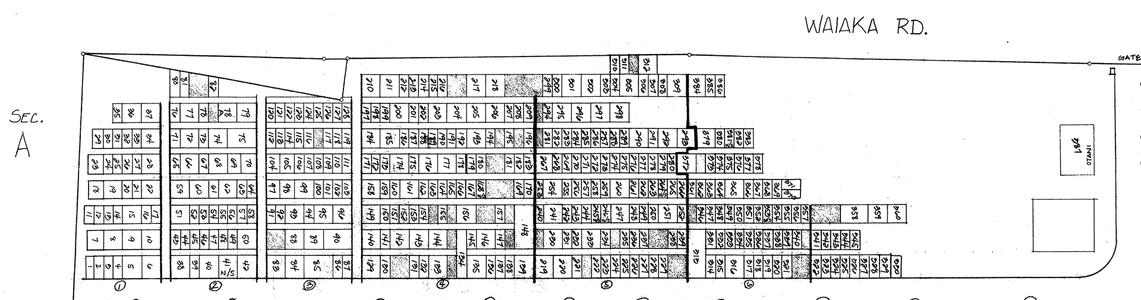
Plot Location - Section A (Ewa Mauka)
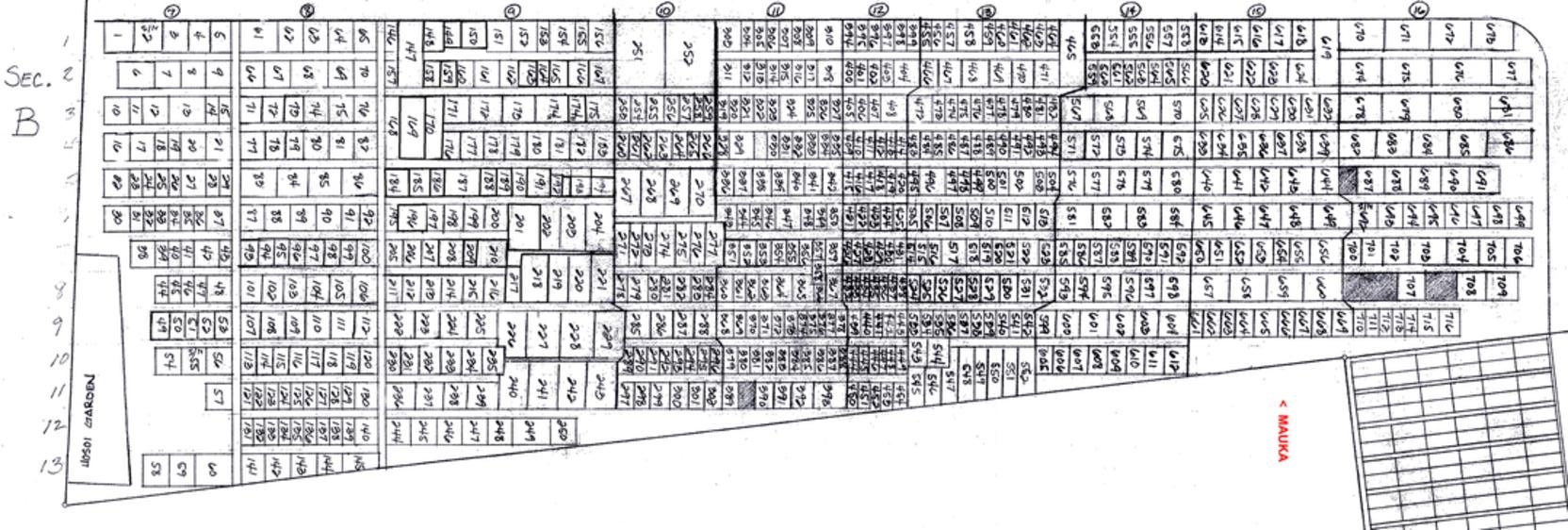
Plot Location - Section B (Ewa Makai)
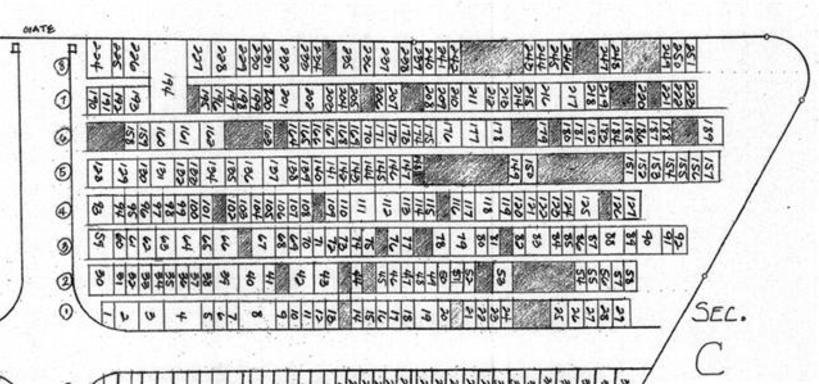
Plot Location - Section C (Diamond Head Mauka)
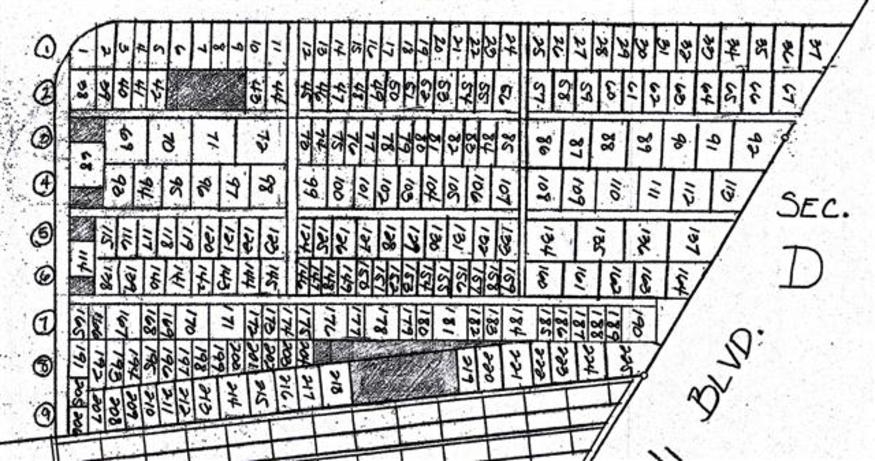
Plot Location - Section D (Diamond Head Makai)
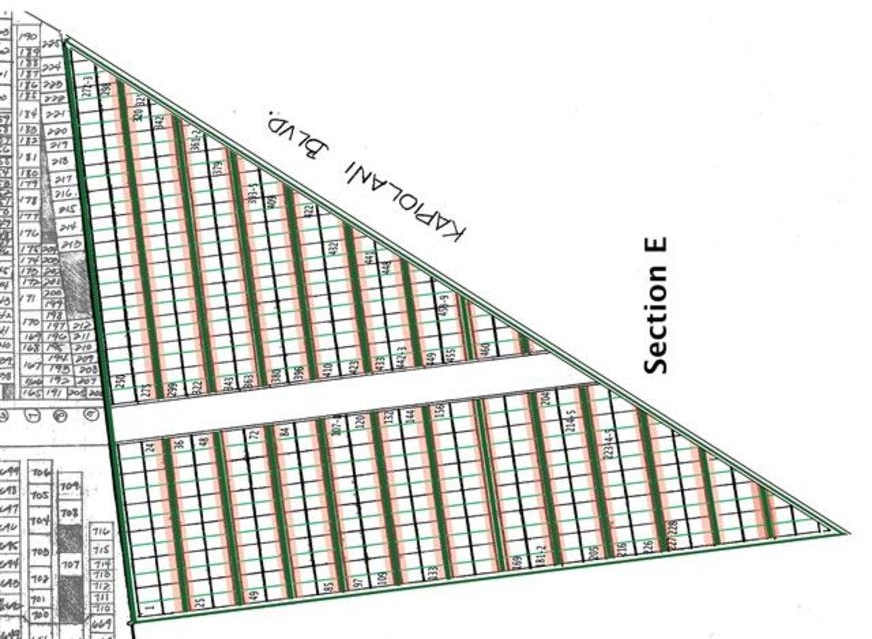
Plot Location - Section E (Diamond Head Most-Makai)


Some Highlights in Section A
A9 Tomake (the surname Toma plus Ke ‘family’) apparently got their stone from Aoyama Ishikatsu Engraving, a very old and famous stone carver in Tokyo. (C106 Takasaki family, whose daughter Midori is in C103, also got their stone from Aoyama Ishikatsu.)
A25 Higa is a family of Ryukyuan scholar-officials (Pechin), and the names on the rear may be details of their status and pedigree, and not just ancestors who have died. Several of the death dates on the back are June 1945, the last month of the horrendous Battle of Okinawa.
A64 Genka, with no apparent family, is from exactly the same village as the A62 Oshiro family.
A69 Asato has two “Y.” initials from old spellings of EI as YEI, like the old spellings of Uehara as Uyehara, and Inoue as Inouye. Apparently the two were brothers named Yeisho and Yeimoto.
A79 T. Higa, with no apparent family, is from Nago City in the Kunigami district of Okinawa.
A89 Uehara-Kushinka lists Edward Takeo “Pollo” Uehara, who ran Pollo’s Market and also went by the name Yago Kushinka, according to a Star-Bulletin obituary dated 1-1-1999.
A138 Iwai tombstone lists its content as the “souls” of Tamajiro and Omiyo (from Hiroshima), with Namu Amida Butsu running down the middle, which I understand often indicates the ashes are not buried there.
A168 Tanabe has Hayase written on the front, but that means ‘early death’. The Tanabe family name is on the rear.
A220 is engraved with 因果塚 ingachou ‘karma gravemound’ or ‘heap of misfortune’. Only a posthumous name is given (釈祐寛信士 Shakuyukan shinji), but the listed date of birth and death corresponds to that of Myles Fukunaga, b. Meiji 42 (1909) February 4, d. Showa 4 (1929), November 19. Myles was hanged on the latter date for the kidnapping and murder of Gill Jamieson in 1928.
The mon with three rising flower stalks above three broad leaves represents the paulownia (Jp. kiri) tree used to make geta, and the mon is associated with the Toyotomi clan, whose most famous member is Hideyoshi, who unified Japan, paving the way for the Tokugawa period.
A367 Okamura has a Bible verse carved into it: “I am the resurrection and the life …” John 11:25.
A379 Tamashiro seems to have two kanji errors to describe the youngster who died at 6 years old. I believe it is meant to read 乳幼(児) nyuyo(ji) ‘suckling child’. The nyu means ‘milk’ and yo is the same as in yochien ‘kindergarten’. (The apparently erroneous 仂 can be read Tsutomu, but I’ve never heard of ‘milk’ being part of one’s name.) – Joel Bradshaw
Some Highlights in Section B
B032 Tobara, a big clan with several generations, has a new pillowstone added with the names Yoshiaki (d. 2013) and Shizue (d. 2017) on it, plus “100th Battalion, Company B” under Yoshiaki’s name.
B067 Irei, Yujo and Guzu, had a rough life, losing 3 daughters and 2 sons, all listed in Japanese on the rear of the stone. Their second son, Yuko [‘Have-happiness’], whose romanized name and date of death is also listed on the pedestal, died in 1940 at the age of 22, perhaps as a Japanese soldier fighting in China.
B102 Toma family haka lists the place of birth of each of the many kids (and their local daughter-in-law Lahela). Two of their sons died in 1943, one younger one born in Okinawa and one older one born in Hawai‘i. The mother died in 1941 and the father in 1945, possibly in Okinawa.
B142 Tome family from Okinawa has Tomei (the Japanese pronunciation of their kanji) carved on the pedestal, and has a new family member added who spells his name Tomi.
The S.S. Shunyo Maru arrived in Honolulu on 5 February 1920. Three Japanese passengers died on that ship and their wives arranged for them to be buried in the Mo‘ili‘ili Japanese Cemetery. The passenger manifests for that voyage show all six names crossed out.
B346 Kobayashi, Masaki and his wife Mizuho, from Nagano were on board, bound for Arizona. Masaki, 34, died on 5 February 1920 and his wife erected the tombstone for him.
B349 Kubo, Naoichi and wife Megumi, from Hiroshima were on board. Naoichi, 42, died on 3 February 1920 aboard the Shunyo-maru and his wife erected the tombstone for him.
B411 Furuichi, Manzo, and his wife “Yei” (now Ei, also read Sakae), from Gifu (in the “Japanese Empire” as written on his haka) were bound for Colorado via San Francisco. Manzo’s date of death is 12 February 1920, the day the Shunyo Maru arrived in SF.
There are three Korean names on the tombstones:
B444 Inouye Naojiro’s wife Ichi died in 1911 at Inchon, Korea (in Japanese called Jinsen, Chosen). His daughter Hanayo died the year before.
B525 Lee has a minimal listing in the Korean alphabet on the makai side, but fuller details in kanji on the mauka side. Both sides have “Chosenjin” (Korean) across the top of the stone. Lee was from Gyeonggi-do (Capital Province), and his date of death is given on one side of the stone as 1916 in the Western calender and on the other as 4249 in the traditional Korean calendar, which counts from the reign of Tangun/Dangun in 2333 BC, one-upping the traditional Japanese calendar, which counts from the reign of Emperor Jimmu in 660 BC.
B714 for Kim Won Koo’s mother (d. 1915) also has some Korean writing on the side of the stone. – Joel Bradshaw